

the journal
retinol works. so why don’t i use it?
retinol works. but for some skin, “working” can come with dryness, stinging and irritation. tracy explains why she chose a more nurturing path for her own face.

retinol works.
let’s start there.
it can help improve the appearance of fine lines, uneven tone and texture. there is real science behind it.
and it can also be a lot for some skin.
dryness. peeling. stinging. redness. that whole “push through it until your skin gets used to it” conversation.
i know there are people who love retinol.
i’m not here to tell them they’re wrong.
i’m here to tell you why i chose something different for my own face.
i believe in nurturing and caring, not stripping and irritating
i’ve spent more than 30 years working with bodies and tissue.
my instinct has never been to attack the body into changing.
i support it.
i soften what is tight. i nourish what is dry. i work with what is there and pay attention to how it responds.
that is how i think about skin too.

i don’t believe irritation has to be the price of admission for caring about how your skin ages.
and when i made the oil i use on my own face, i wanted ingredients that could meaningfully support the things i care about, like the look of fine lines, uneven tone, age spots, dryness and texture, while still feeling like care.
first, what are retinol, retinal and retinoic acid?
these words get used like they are interchangeable, but they are different forms within the vitamin A family.
retinol and retinaldehyde, often shortened to retinal, have to be converted in the skin before they become retinoic acid, the form that interacts directly with retinoid receptors.
that is part of why retinoids can be effective.
it is also why stronger or faster-acting forms can be harder for some people to tolerate.
the american academy of dermatology notes that retinoids can be useful for fine lines, pigmentation and texture, while also cautioning that people with dryness, redness or sensitive skin may have trouble with irritation.
so the question for me was never, “does retinol work?”
the question was:
is that the only way i want to support my skin?
bakuchiol: the plant-derived retinol alternative
bakuchiol is a naturally occurring plant compound found abundantly in the babchi plant, traditionally known as Psoralea corylifolia and now also classified as Cullen corylifolium.
chemically, bakuchiol is not retinol, retinal or retinoic acid.
that distinction matters.
what makes it so interesting is that research has shown retinol-like activity in the way it supports visible photoaging.
in one randomized 12-week human study, a 0.5% bakuchiol cream and a 0.5% retinol cream both significantly improved wrinkle surface area and hyperpigmentation. the retinol group reported more scaling and stinging.
that does not mean every bakuchiol product is identical to retinol, and it does not mean every formula will produce the same result as that study.
it means there is real reason to be interested in this plant compound when you want visible-aging support and your skin does not love aggressive care.
rosehip seed oil: this one is more interesting than “vitamin-rich oil”
the rosehip seed oil in my current face-oil batch is expeller pressed from wild-harvested seeds of Rosa rubiginosa and Rosa canina.
rosehip seed oils are naturally rich in essential fatty acids, especially linoleic and alpha-linolenic acids, along with naturally occurring carotenoids, tocopherols and other plant compounds.
those lipids are part of why i love rosehip for skin that feels dry, mature or in need of more nourishment.
and Rosa rubiginosa has another very interesting piece of chemistry.
published research on oil from this rose species has identified naturally occurring all-trans-retinoic acid.
that does not mean i can tell you exactly how much retinoic acid is in this bottle. extraction method matters, and we have not assayed our finished oil for a retinoic-acid concentration.
but it is one of the reasons i think the phrase “rosehip is just a carrier oil” misses a lot of what is going on inside the plant.
squalane: support the skin’s lipid environment
squalane is the stable form of squalene, a lipid that naturally makes up part of human sebum.
our skin already understands lipids.
in a formula, squalane is a lightweight emollient. it helps soften skin, improve slip and comfort, and support that supple feeling without needing a heavy, greasy finish.
this is not the ingredient i chose because it has a sexy anti-aging headline.
i chose it because aging skin can need nourishment too.
sometimes supporting the way skin feels is part of supporting the way it looks.
jojoba: technically, it is not even an oil
jojoba is actually a liquid wax made largely of long-chain wax esters.
those wax esters are one reason jojoba has such a beautiful affinity for skin and why it has been used for years as a conditioning ingredient.
there is also newer research that caught my attention.
in a 2024 ex-vivo human-skin study, topical jojoba increased markers of pro-collagen III and hyaluronic acid and reduced several inflammatory signals.
that is tissue-model research, not a clinical promise that jojoba erases wrinkles.
but it is a very good example of something i say all the time:
simple does not mean unsophisticated.

calendula: because calm belongs in the formula too
our jojoba is infused with calendula.
calendula contains naturally occurring plant compounds including flavonoids and triterpenoids, and it has a long history of topical use for soothing skin.
research supports anti-inflammatory and antioxidant activity, although the human clinical evidence varies depending on what is being studied.
i am not putting calendula in a face oil so i can call it a wrinkle treatment.
i put it there because i want the formula to feel caring.
because i believe supporting aging skin includes paying attention to comfort, calm and sensitivity too.
this is why i did not build rewind around one trendy ingredient
i didn’t make this formula by starting with a marketing list.
i made it for my own face.
and i have used it on my clients for as long as i’ve used it on myself.
people ask me all the time:
“what do you use on your face?”
for years, the answer was basically, “something i make for myself.”
finally, i get to say:
here it is.

meet rewind
rewind face oil is the concentrated facial oil i have kept in my own cabinet and used in my work for years.
the formula is built around squalane, bakuchiol, rosehip seed oil and calendula-infused jojoba.
no synthetic fragrance. no water. no filler just for the sake of making the bottle bigger.
just a small, concentrated formula built around the way i want to care for aging skin.
nurture it.
support it.
pay attention to it.
and stay consistent enough to see what good care can do.
and yes, i’m finally sharing it
rewind launches online saturday, november 7.
this first batch is very limited.
i mean that literally. this has been my secret stash, not a giant production run we had sitting in a warehouse.
if you’re local, i’m also teaching grandpa’s face tricks: face massage + gua sha in the Eagle shop that morning. we’ll talk about how i work with faces, how i actually use gua sha, and the little face-care tricks i’ve used on myself and clients for years.
and if you don’t live in idaho, stay close.
i’m working on how to bring more of these classes online too.
the bigger point
you do not have to choose your skincare because a word is trending.
and you do not have to believe that burning, peeling or irritation automatically means you are doing more for your skin.
retinoids are real tools.
so are plant compounds, lipids, wax esters, fatty acids and botanical extracts.
understanding what each one actually does gives you something better than a trend.
it gives you a choice.
i believe in nurturing and caring, not stripping and irritating.
that is the choice i made for my own face.
and now, finally, i get to share it with you.
research + further reading
i like knowing where the nerdy stuff comes from too. these are some of the sources behind the ingredient teaching in this article:
- bakuchiol vs. retinol for facial photoaging, randomized 12-week trial
- american academy of dermatology: retinoids, benefits + irritation considerations
- Rosa rubiginosa seed oil extraction + naturally occurring all-trans-retinoic acid
- jojoba wax in an ex-vivo human-skin model
- review of Calendula officinalis compounds + biological activity
take good care of yourself,
♡ tracy

the face oil tracy has used on herself and her clients for years.
rewind face oil
a concentrated facial oil with 1% bakuchiol, squalane, wild-harvested rosehip seed oil and calendula-infused jojoba for smoother, more even-looking skin.
$82.00
ready to give your skin what it actually needs?
see the routinenot sure where to start? try the mini bar. travel sizes of everything, a low-commitment way to find your intention.
the conversation.
questions, thoughts, what's working for your skin. all welcome.
you might also love
build your ritual.
a few more things tracy reaches for.
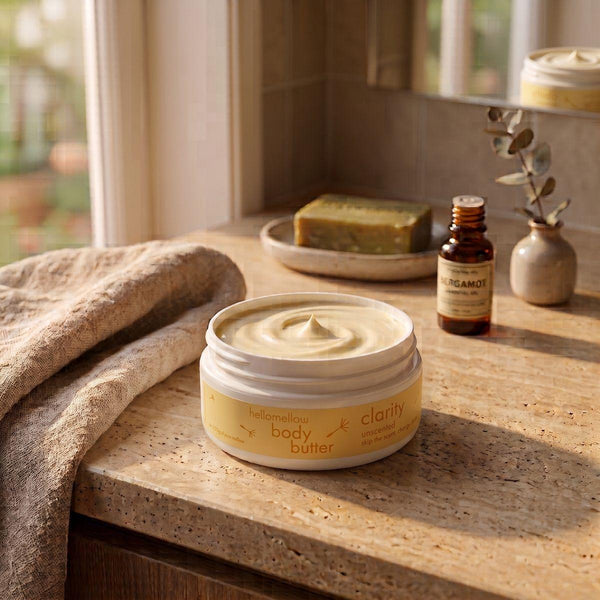
body butter - clarity (unscented)
clarity is the original hellomellow butter with nothing aromatic added. no essential oils to choose between and no...
shop now →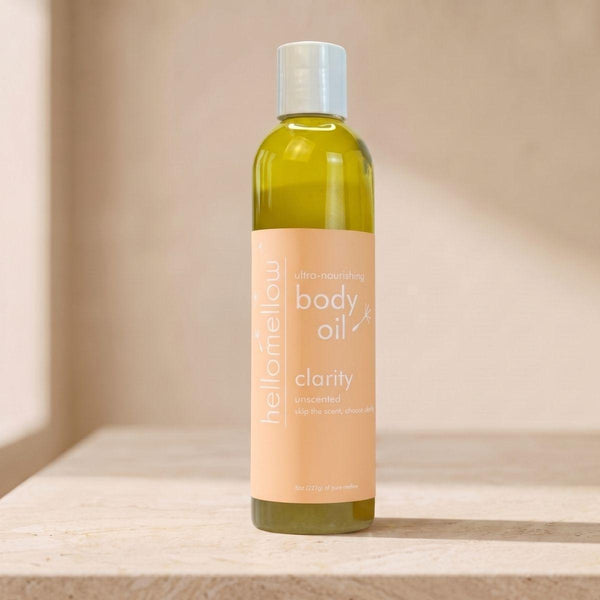
body oil - clarity - unscented
clarity is the easiest way to make daily body care completely fragrance-free. no essential oils added. just a...
shop now →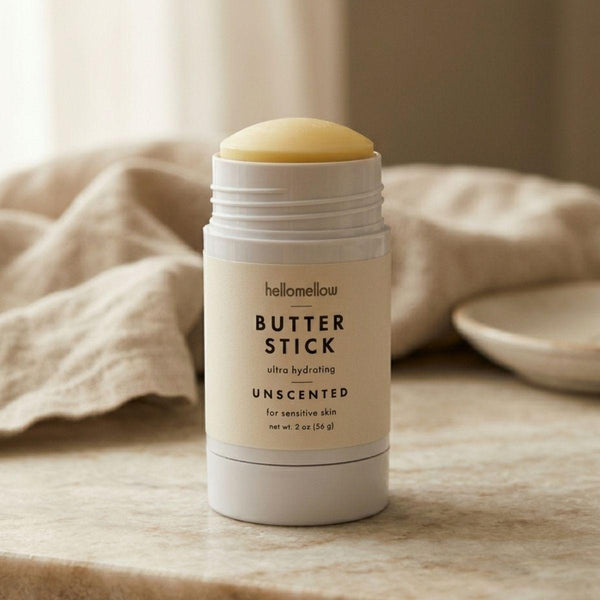
daily butter stick
daily is the butter stick you keep close enough to actually use. it’s completely fragrance-free, so there is...
shop now →
Id love to know when the new face oil is available!